The short answer
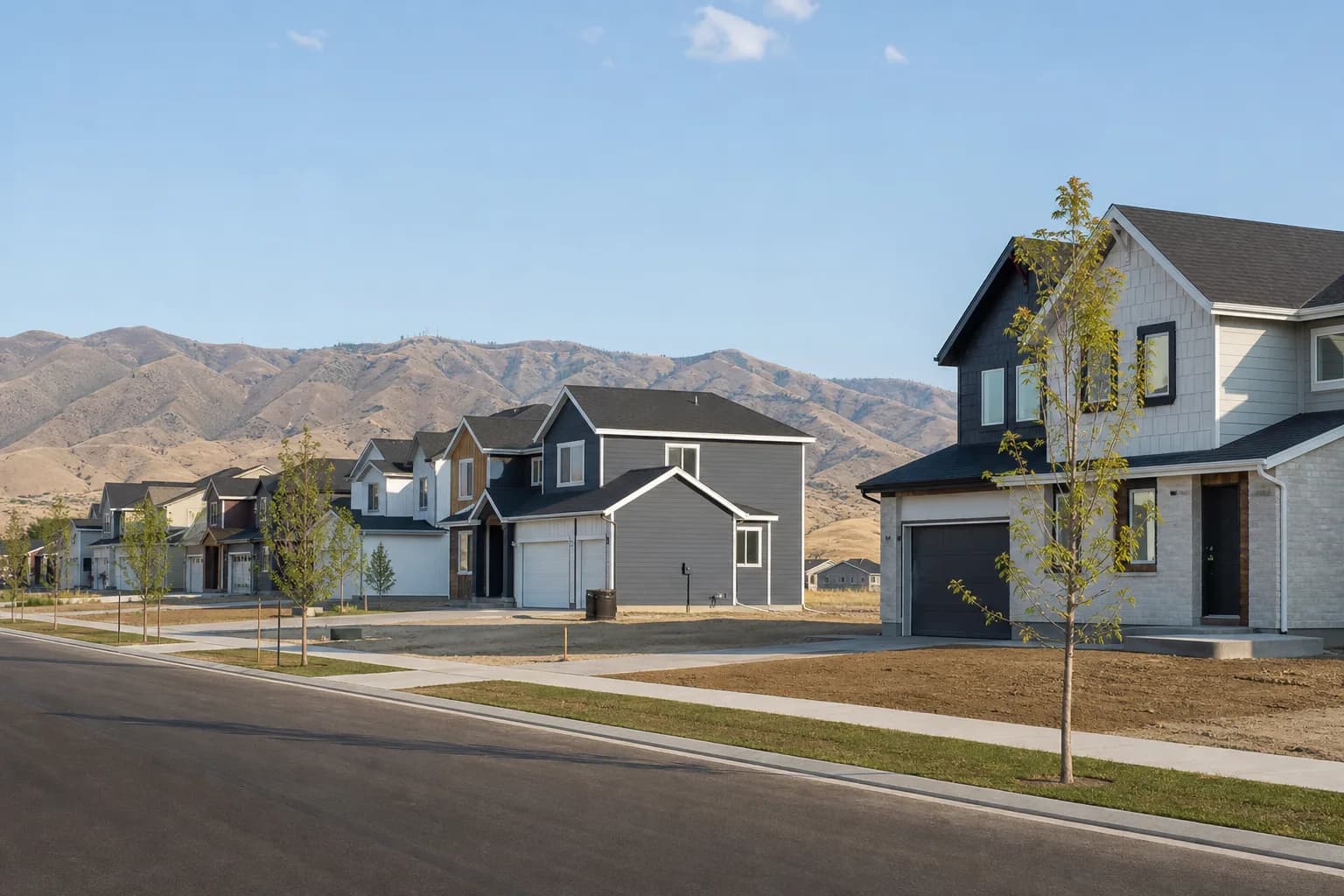
Across the Treasure Valley, the parcel decides your budget far more than the city on the mailing address does. Two houses with identical plans and identical finishes can differ by hundreds of thousands of dollars because one sits on a flat, serviced lot with water and sewer at the property line and the other sits on a steep foothills site with a well, a septic system, and a switchback driveway. Four variables explain most of the difference: which county reviews the permit, whether the ground is valley floor or foothills, whether the lot is serviced or rural, and what irrigation infrastructure crosses it. This guide walks through all four, then hands you off to the guide for the specific city or neighbourhood you are looking at. If you want the cost picture first, start with what it costs to build a home in Boise, and if you have not bought the ground yet, read buying land to build on in the Treasure Valley before you write an offer.
Ada County or Canyon County, and why it matters
Boise, Meridian, Eagle, Kuna, and Star permit through Ada County; Nampa, Caldwell, and Middleton permit through Canyon County; the two use different portals and different review cadences. That is not a trivia point. It means two different submittal systems, two sets of document conventions, two ways of handling a resubmittal, and fee structures that are set separately and change on their own schedules. A drawing package assembled for one is not automatically the package the other expects.
There is a second layer underneath the county question, and it catches people out more often. Being inside city limits is different from being in unincorporated county ground, even when the mailing address says the same town. Inside the city you generally get municipal water and sewer, city zoning and setbacks, and city-level review. Outside it you may be on a well and a septic system with county zoning, and the answer to what you are allowed to build changes with it. Confirm which jurisdiction the parcel number actually falls under before you assume anything about services or setbacks.
We handle permits, plan review, engineering, and utility applications in-house for both counties, which is deliberate. The difference between the two systems is a scheduling problem for us rather than a homework assignment for you. We do not publish review turnaround times, because they move with workload and any number we printed would be wrong within a season. What we do instead is build realistic review and inspection windows into the master schedule, which is covered in the Boise home building process guide.
Valley floor versus foothills: the biggest cost divide
Flat valley ground versus the foothills is the single largest geographic cost difference in this market, and it is wide enough to change what house you can afford. A simple single-level plan on a flat, serviced valley lot can land near $225 per square foot, excluding land. A steep foothills site with high detail regularly runs above $450 per square foot. Same builder, same crews, same market, roughly double the number.
The reasons are physical, not a premium for the view. Slope means cut and fill, retaining walls, and often a stepped foundation or a daylight basement instead of a simple stem wall. It means a geotechnical report that actually drives design rather than confirming the obvious. Driveways get long, sometimes switchbacked, and have to be engineered for grade and for fire apparatus access. Utility trenches run further and through harder ground. Equipment access is slower, staging areas are smaller, and some lifts need a crane where a valley lot would need a forklift. Wildland-urban interface considerations add ignition-resistant materials, roof and vent detailing, and defensible space around the structure.
None of that is a reason to avoid the foothills. The lots are genuinely better in the ways people buy them for. It is a reason to price the site before you fall in love with the plan, because on a foothills parcel the site can consume the budget you were planning to spend on the kitchen. If a foothills build is what you want, start with building in the Eagle Foothills, which goes through slope, access, and geotechnical work in detail.
Serviced subdivision lots versus rural acreage
Site work runs $25,000 to $50,000 on a serviced subdivision lot and $80,000 to $150,000 on a rural parcel needing a well, septic, and access, and that gap is the most common budget shock in this valley. On a platted lot, water, sewer, power, and gas are usually at or near the property line, the street exists, and stormwater has somewhere designed to go. Site work is excavation, backfill, connections, the driveway, and the flatwork.
On rural ground you are building a small utility company first. A well with a pump, pressure tank, electrical, and water testing. A septic system sized and sited from soil testing. Possibly a power extension across ground you do not own, which needs an easement from a neighbour you may not have met. Possibly a private road built to a standard that emergency apparatus can use. All of that happens before a foundation is poured, which is why the range is what it is.
The trade-off is real in both directions, and we say this to clients who expect us to push acreage. A serviced lot is cheaper, faster, and far more predictable, and you give up land and gain a set of covenants. Acreage gives you room and quiet, and costs six figures of infrastructure and a longer schedule. Neither is the right answer generically. What we do recommend on any parcel you have not yet bought is a written lot evaluation at $950 to $3,500 through our lot evaluation service, because it is the cheapest insurance in the entire process. If you already own the ground, building on your lot is the path.
One more thing about serviced lots. Many newer subdivisions across the valley run architectural review, and the covenants can set roof pitch, exterior materials, colour palettes, minimum finished area, and how closely your elevation may resemble the house three doors down. That is manageable when you read it before you buy the lot. It is expensive when it arrives after the plans are drawn, because the redesign is yours to pay for. We read covenants during design, and it is worth doing yourself during your inspection period.
Irrigation districts, ditches, and laterals
A great many parcels in this valley sit inside an irrigation district, and the district, not you, decides what may happen near its ditches and laterals. This is the most locally specific thing on this page and the one out-of-state buyers are least prepared for. Much of the Treasure Valley is former or current farm ground, and the delivery infrastructure that made it farmable is still there, still in use, and still protected.
Practically, three things follow. First, a ditch or a lateral commonly cannot be moved, piped, filled, or built over without the district's approval, and that approval runs on the district's calendar rather than your construction schedule. Second, the district's easement is frequently wider than the visible channel, and that easement removes ground from your buildable area even though the deed says you own it. A parcel that looks generous can have a much smaller usable envelope once the corridor is plotted. Third, water rights often transfer with the land, which is an asset worth understanding, and in a newer subdivision the same water usually arrives as a pressurised irrigation system with its own connection and its own rules.
The questions to ask before you buy are simple. What irrigation infrastructure crosses this parcel, how wide is the easement, what water rights come with it, and what does the district require for a driveway crossing or for any work near the channel. Get the answers in writing from the district, plotted on a survey. Guessing here can cost you a house position.
Well, septic, and Central District Health
If the parcel is outside a municipal service boundary, septic permitting goes through Central District Health, and the approvable system comes out of soil testing on your specific ground. Not from the neighbour's system, not from the listing, not from an average. A site evaluation and soil test determine what type of system can be approved, how large the drainfield has to be, and where it can sit.
The sequencing matters more than the cost. Poor percolation, shallow bedrock, or a high seasonal water table can force an engineered or mound system, which costs considerably more and occupies more ground. Because the drainfield, its replacement area, and its required separation distances cannot be built over, septic feasibility should be settled before the site plan is finalised, not after you have chosen where the house looks best. We have seen a beautiful house position become impossible because the only approvable drainfield location was already spoken for by the driveway.
Wells carry an honest unknown. The depth is whatever the aquifer requires at that location, and nobody can promise it in advance. Neighbouring well logs give an indication and no guarantee. Budget the well, the pump, the pressure tank, the electrical run to it, and testing, and understand that marginal yield adds storage and a booster system. This is the biggest reason rural site work sits in the $80,000 to $150,000 band rather than the serviced-lot band.
Soils, slope, and drainage vary more than the flat view suggests
Most flat valley ground supports a conventional foundation, which is a large part of why it is cheaper to build on, but the exceptions are local and worth testing for. Across the valley floor we see expansive clay in places, uncontrolled fill on ground that has been worked and reworked as farmland, shallow rock as you approach the benches and the foothills, and a high seasonal water table on parcels near the Boise River corridor.
Each of those changes the foundation, and the foundation is one of the largest single divisions in the budget. Over-excavation and engineered fill, a deeper footing, a drainage system around the foundation, or a redesigned basement are all cheaper to discover in a geotechnical report than in an excavator's bucket. On any parcel where the ground is in question, the report is money well spent.
Drainage is the quieter one. Jurisdictions across both counties generally expect stormwater from a new roof and driveway to be managed on the parcel, which can mean swales, drywells, or a retention area taking up ground you were counting as yard. A parcel that ponds in spring is telling you something before any engineer does. Slope compounds all of it, which is why the foothills sections of Boise and Eagle price differently from the flats a few miles away.
What our climate means for a build here
Hot dry summers and cold winters shape the sequence of a Treasure Valley build, but foundation and framing work continue through most of the winter here with cold-weather measures. That surprises people moving from milder markets who assume construction stops in November. It does not. Concrete gets placed with mix adjustments, insulated blankets, and heat where needed. Excavation continues except in the hardest frost. Framing carries on, and once a house is dried in and temporary heat is on, interior trades work through the coldest weeks with no penalty at all.
What genuinely waits for weather is a shorter list than most people expect: exterior flatwork and hardscape, some coatings and sealants with temperature minimums, roofing in the wrong conditions, and landscaping and sod. A schedule that hits dry-in before deep winter is in good shape. A schedule that is still trying to pour foundations in January is paying for it in cold-weather measures.
Summer has its own constraints, and they are real. Hot, dry, windy conditions mean early concrete placement and diligent curing, drywall mud and paint that flash faster than crews expect, dust control on a site with no ground cover, and heat management for the trades. Our climate also argues for a serious building envelope, because a house here has to handle wide daily temperature swings and a genuine cooling load as well as a heating one. Those decisions belong in design, which is where the custom home design guide picks up.
Building a new home in Boise
Boise is two entirely different building problems that share a city name: infill lots inside established neighbourhoods, and foothills parcels above them. Infill means dropping one new house between two existing ones, with a narrow street to stage from, mature trees worth protecting, neighbours living twenty feet away, and existing services in the street that still have to be verified for location and capacity rather than assumed. Some established areas also sit under historic or design-review overlays, so confirm which rules attach to the parcel before you commit to an elevation. Move uphill and the numbers change entirely: slope, geotechnical requirements, wildland-urban interface detailing, and a build that regularly runs above $450 per square foot excluding land. Read building a home in Boise for the neighbourhood-level detail, and our Boise service area page for what we offer there.
Building a new home in Meridian
Meridian is the most predictable place in the valley to build, because most of what is available is a platted, serviced lot on flat ground. Water and sewer are typically at the line, site work sits at the lower end of the $25,000 to $50,000 band, and a simple single-level plan can approach $225 per square foot excluding land. What varies here is not the dirt, it is the paperwork: architectural review in many subdivisions sets materials, roof pitch, and elevation variety, and tight lot coverage and setbacks on smaller lots often decide the plan shape before you do. Full detail is in building a home in Meridian, with services listed on our Meridian page.
Building a new home in Eagle
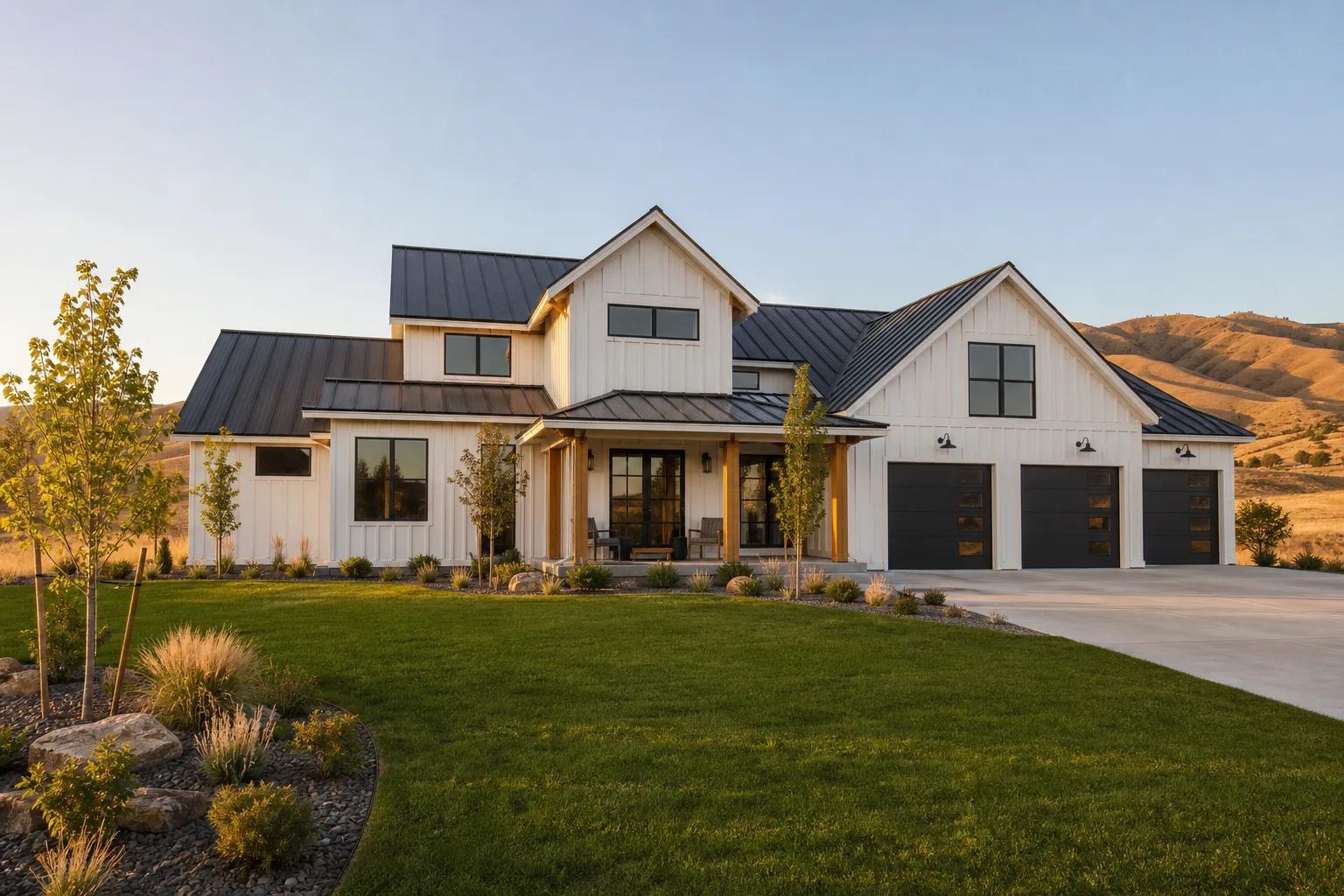
Eagle spans the widest range of build costs of any city here, from serviced lots near the river flats to estate acreage and the foothills to the north. On the flats it behaves much like Meridian with higher finish expectations. On larger parcels you may still be on a well and a septic system despite being minutes from town, and architectural committees tend to be more prescriptive about materials and massing. North into the foothills, geotechnical work and access take over the budget and that above $450 per square foot figure becomes the realistic planning number rather than a worst case. Start with building a home in Eagle or our Eagle service area.
Building a new home in Kuna
Kuna is where building on real acreage is still an ordinary thing to do, and that is what makes it different from Meridian a few miles north. Flat former farm ground supports both new plats with services and genuine one to five acre parcels outside the sewer boundary, and on the latter you are into the $80,000 to $150,000 rural site work band with a well, a septic system, and sometimes a power extension. Irrigation laterals cross a lot of this ground, so district easements deserve early attention. Permits still route through Ada County. See building a home in Kuna and our Kuna page.
Building a new home in Star
Star is mostly newer plats with pockets of remaining acreage between them, and the Boise River is close enough to matter on some parcels. Newer subdivisions there come with pressurised irrigation and design guidelines, and the serviced-lot economics apply. On riverside and low-lying parcels, mapped flood zone status and required finished floor elevation become live design questions with real cost attached, so check the specific parcel rather than the neighbourhood. Star sits in Ada County, so the permit path matches Boise and Meridian even though the town is small. More in building a home in Star and on our Star service area page.
Building a new home in Middleton
Of the three Canyon County cities, Middleton is the most likely to put you on a well and a septic system. The parcels available here lean toward acreage and small plats along the river corridor rather than large serviced subdivisions, so the rural site work band and Central District Health septic permitting are the norm rather than the exception. Irrigation infrastructure is dense on this converted farm ground. Because plenty of Middleton addresses are actually unincorporated county, confirm the jurisdiction on the parcel number early, since it determines both services and review. Read building a home in Middleton, or see our Middleton page.
Building a new home in Nampa
Nampa has the deepest supply of serviced, flat lots in Canyon County, which makes it the value end of the valley for a straightforward build. Inside the service boundary you get municipal water and sewer, simple foundations, and site work at the lower band, and a semi-custom plan in the $225 to $300 per finished square foot range goes further here than almost anywhere else, excluding land. Push out toward Lake Lowell and the surrounding farm ground and you are on acreage with well, septic, and access costs, so verify the service boundary before you assume. Details in building a home in Nampa and on our Nampa service area page.
Building a new home in Caldwell
In Caldwell a fully serviced infill lot and a working farm parcel can be a few minutes apart, so the first question is always whether services reach the ground. The city has both established infill and edge plats where utilities are in the street, and beyond them ag acreage where a well and septic system are required and older ditch and lateral easements are common on land that has been irrigated for generations. Permits route through Canyon County. The spread between those two situations is the $25,000 to $50,000 and $80,000 to $150,000 site work bands, and it is worth resolving before you negotiate. Start at building a home in Caldwell or our Caldwell page.
Three neighbourhoods with their own rules
Some places in the valley are specific enough that the city guide is not sufficient, and we keep separate guides for three of them. The Eagle Foothills is where slope, geotechnical requirements, long private access, wildland-urban interface detailing, and frequently a well and septic system all arrive on the same parcel, which is why builds there plan around the above $450 per square foot end of the range rather than the middle.
Hidden Springs, in the Dry Creek valley north of Boise, is a planned community with its own design standards and a strong architectural character, so the design conversation there starts with what the community expects and works inward to what you want. It is close enough to the foothills that access and grade matter on some lots.
Harris Ranch, in the Barber Valley along the Boise River in east Boise, is a master-planned area where the plat, the guidelines, and the streetscape are already established. Building there is less about site discovery and more about designing a house that satisfies the community standards while still being the house you actually wanted. Confirm the current guidelines before design starts in either community, because they are revised over time.
Where to start
Start with the parcel, because everything on this page turns into a number once we know which ground you are standing on. If you have a lot or are considering one, send it to us and we will tell you what it will take to build on it, in writing. If you are earlier than that, run a size and finish level through the build cost estimator to get a starting range, then read the guide for the city you are looking at. Our approach is the same in all eight: one accountable design-build team, a line-item budget before we break ground, allowances set at what things actually cost here, a published draw schedule, a written progress update every week, and a one-year workmanship warranty after possession.
From here you can compare our custom home building and semi-custom home paths, see every city we serve on the Treasure Valley service areas page, work out how to vet whoever you hire in how to choose a home builder, or send us the parcel and we will start with the site.