
The short answer
Expand section
The short answer
Every red flag on this list is a red flag because it predicts a specific later problem, not because it feels unprofessional. That distinction matters. A builder with a messy truck and a slow email habit may build a very good house. A builder with a clean presentation and no written change order process will cost you money, reliably, at about month five. What follows is grouped into the signs you can see before you sign and the ones that only appear once the build is running, with the mechanism spelled out in each case. It sits inside our guide to choosing a home builder in Boise.
A bid far below the others
Expand section
A bid far below the others
A bid substantially below the rest is nearly always a shorter scope rather than a better price. The trades are the same trades. Lumber costs what lumber costs. Nobody building in Boise, Meridian, Eagle, Nampa, Kuna, Star, Middleton or Caldwell has access to a secret concrete supplier. When a number comes in well under two other numbers on the same plan, the difference is almost always in what the bid does not say: site work excluded, allowances set low, design and engineering carried outside the price, the driveway and landscape missing.
The mechanism is straightforward. The low bid wins the contract, and then the missing scope reappears as change orders once you are committed and have no competing option. You end up at or above the number the honest builder gave you, having spent the build arguing. Our article on why home building bids vary so much separates the legitimate reasons for a gap from the illegitimate ones.
A scope you cannot argue with
Expand section
A scope you cannot argue with
If the scope is too vague to disagree with, it is too vague to enforce. Look for phrases like "quality finishes throughout", "builder-grade cabinetry", "standard site preparation", and "granite countertops" with no supplier, no grade and no square footage. Each of those is a sentence that means whatever the builder later says it means.
This one predicts trouble because it moves every specification decision into the future, at a point when you have already paid deposits and cannot walk. A real scope says which window manufacturer, which insulation values, how many linear feet of cabinetry, what the site work assumes about soil and slope. It is boring to read, which is why so few homeowners read it, and it is the single most valuable document in the transaction.
Pressure to sign this week
Expand section
Pressure to sign this week
Urgency applied to a nine to fourteen month commitment is a sales technique, not a market condition. The versions you will hear are that the price expires Friday, that lumber is about to jump, that the crew has a gap next month that will close, or that another buyer is looking at the same lot package.
Some of these are occasionally true. What makes it a red flag is the combination of urgency with incomplete information: you are being asked to commit before you have a scope you can read or a budget you can check. A builder who is confident in their number is content for you to take it to someone else, because they know what it contains. Pressure exists to prevent comparison, and comparison is exactly what protects you.
A deposit that funds the business rather than your house
Expand section
A deposit that funds the business rather than your house
Ask what the deposit pays for, and expect the answer to be traceable to invoices. A deposit covering design, engineering and permit applications is normal. Design and engineering commonly run 5 to 12 percent of construction cost, roughly $9,000 to $35,000, and someone has to pay for it before drawings exist.
A large percentage of the total contract, demanded before anything happens on your lot, is a different thing. It predicts trouble in two ways. It suggests the builder is using your money for working capital, which usually means they are covering a previous job with your funds, and it strips your leverage at the exact moment you need it most. A builder holding a large sum of your money and behind on your schedule has very little reason to hurry.
No written change order process
Expand section
No written change order process
This is the most reliable single predictor of a budget that drifts, and it is the easiest to check. Ask how a change is priced, who signs it, and whether work stops until you sign. If the answer is that they keep track and settle up at the end, the budget will move and you will not be able to say when.
The reason is not usually dishonesty. It is that a build generates dozens of small decisions, and undocumented decisions accumulate silently. Nobody remembers agreeing to the upgraded railing on a Tuesday in March. By closeout there is a five-figure gap and two people with different memories. A written change order with cost, schedule impact and a signature turns that argument into an event you can see coming. This is worth understanding alongside how fixed price and cost plus allocate risk, because a fixed price with a loose change process is not fixed.
Unwillingness to name trade partners
Expand section
Unwillingness to name trade partners
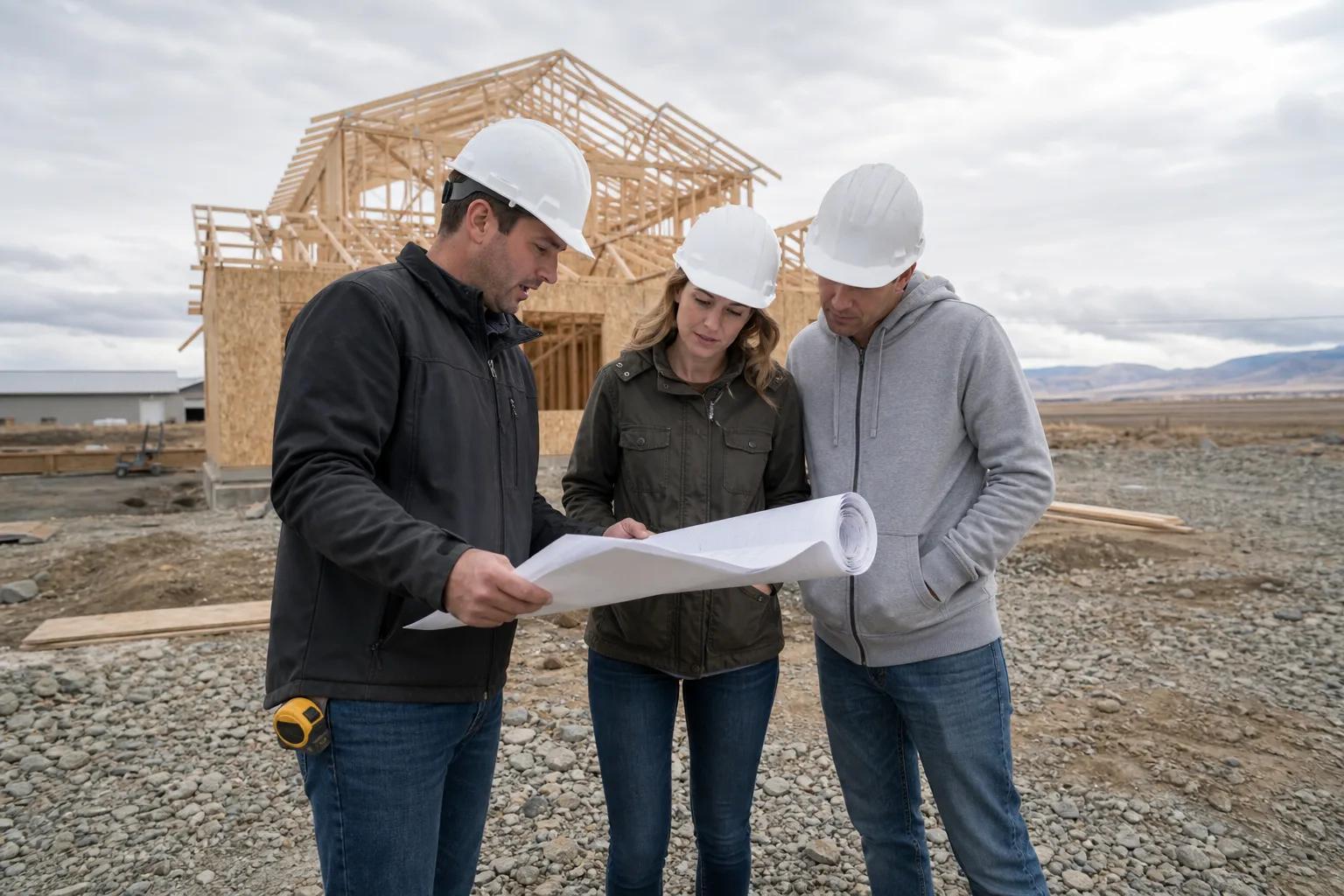
A builder who will not name their framer, electrician or HVAC contractor is either hiding turnover or does not have relationships. The usual justification is that trade partners are commercially sensitive. They are not. Every builder in Ada and Canyon County knows who the other builders use.
What the refusal usually conceals is that the builder rebids every trade on every house and takes the cheapest number each time. That model produces crews with no loyalty, no familiarity with the builder's standards, and no reason to come back and fix something. It also produces schedule chaos, because the cheapest available crew is cheap partly because they are available. Long trade relationships are one of the few genuine quality signals in this industry.
No proof of bond and insurance
Expand section
No proof of bond and insurance
Ask for certificates, not assurances, and check that general liability and workers compensation are both current. Idaho registers residential contractors rather than licensing them, so a builder claiming to be "licensed" is either being loose with the word or hoping you will not check what it means here. Ask instead for the contractor registration, the bond, and current insurance certificates from the insurer.
The exposure is real rather than theoretical. If an uninsured worker is hurt on your lot, or an uninsured crew damages a neighboring property, the claim can find its way to you as the property owner. A builder who is slow to produce a certificate is usually slow because the coverage lapsed, and coverage lapses when a company is short of money.
Going quiet
Expand section
Going quiet
Once the build is running, silence is the warning sign to act on fastest. Builders do not go quiet because everything is fine. They go quiet because the schedule has slipped, because a cost problem has appeared that they have not worked out how to explain, or because they are short of cash and prioritizing a different job.
The reason this one is urgent is that all three causes compound. A slipped schedule that nobody discusses becomes two slipped schedules. A cost problem left unspoken becomes a closeout dispute. The right response is not to wait politely; it is to put dated questions in writing and keep the thread. A written record changes the tone of the conversation immediately, and it is the thing you will want if the relationship ends badly. It is also why we send a written update every week whether or not the week was interesting.
Draws that run ahead of the work
Expand section
Draws that run ahead of the work
Compare each draw request against what is physically standing on your lot. A draw schedule tied to milestones exists so that money follows completed work rather than leading it. When a builder asks for the framing draw with the roof not yet dried in, or bundles two milestones into one request, the pattern is worth naming out loud.
Running draws ahead is how a builder covers a shortfall elsewhere, and it is also how homeowners end up having paid seventy percent of a contract for a house that is fifty percent built. If the relationship then fails, that gap is what you are trying to recover in a dispute. On a construction loan the lender's inspector provides a check on this, which is one of the underrated advantages of financing a build rather than paying cash.
What to do when you see one
Expand section
What to do when you see one
One red flag is a question. Three in the same direction is an answer. Most of these have innocent explanations in isolation. A builder can be genuinely busy and slow to send an insurance certificate. What matters is the pattern, and specifically whether the pattern points at documentation: a company that resists writing things down before the contract will resist writing things down during the build.
Before you sign, the correction is cheap. Ask for the missing document, ask the awkward question, and watch what happens next. Our list of questions to ask a home builder is designed to surface exactly these issues, and comparing bids properly flushes out most of the scope games. After you sign, the correction is expensive and slow, which is the whole argument for doing the work now.
Where to go from here
Expand section
Where to go from here
If something about a proposal is bothering you and you cannot name it, we are happy to look at it with you, including if you end up building with someone else. You can send it over, or start with the build cost calculator to see whether the number in front of you is even in the right band for the house you are describing. It also helps to know what kind of builder you are talking to in the first place, which is the subject of production builder versus custom builder.