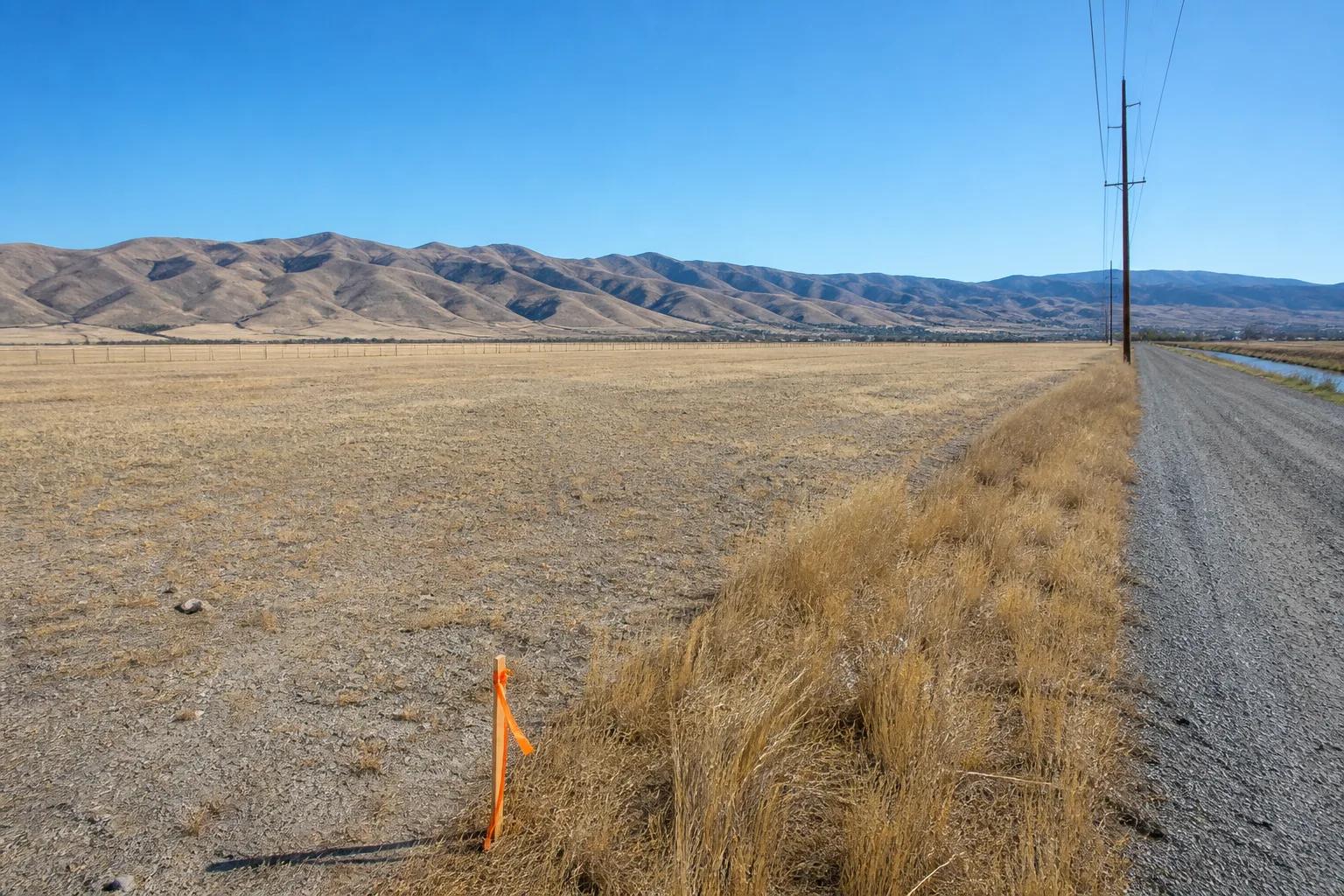
For sale and buildable are not the same thing
Expand section
For sale and buildable are not the same thing
A lot is buildable when it has legal recorded access, zoning that permits a house, room left inside the setbacks for the home you want, a workable water and sewer answer, and ground that will hold a foundation without extraordinary engineering. Almost any parcel can be built on if you spend enough. The question that matters is what it costs to get from the ground as it sits today to a lot a builder can pour on, and whether that number leaves you enough budget for the house. We see this go wrong in the same order every time: a buyer finds a parcel priced below everything around it, closes quickly because land moves fast here, and then discovers why it was cheap. This article walks the checks in the order they should happen. It is part of our guide to buying land to build on in the Treasure Valley.
Legal access and easements
Expand section
Legal access and easements
Start with access, because a parcel you cannot legally reach cannot be permitted, financed, or insured. Legal access means the lot either fronts a public road or benefits from a recorded easement that crosses the neighboring property and runs with the land. What it does not mean is a gravel two-track that the seller and the neighbor have both used since the 1980s. Long-standing use is not the same as a recorded right, and the neighbor who tolerated the seller is under no obligation to tolerate you. Pull the preliminary title report and read the easements, both the ones that benefit the parcel and the ones that burden it. Then look at the other direction: an irrigation ditch easement, a power line easement, or a shared driveway easement can cross the middle of the parcel and quietly delete the part you wanted to build on. Also confirm whether the access easement is wide enough and built to the standard the fire district requires, because emergency access width and turnaround requirements have stopped more rural builds than zoning ever has.
Zoning and permitted use
Expand section
Zoning and permitted use
Zoning decides whether a single-family house is allowed at all, and it is answered by the jurisdiction, not by the listing. Ada County covers Boise, Meridian, Eagle, Kuna, and Star; Canyon County covers Nampa, Caldwell, and Middleton. Each city inside those counties has its own zoning code, and a parcel just outside a city limit is often governed by the county with an area-of-impact agreement layered on top. Ask the jurisdiction directly: is a single-family dwelling a permitted use in this zone, what is the minimum lot size, and are there overlays. Agricultural zoning frequently allows one house on a parcel of a certain size and prohibits a second, which matters if you were planning a shop home or a guest unit. Overlays are where the surprises live, including foothills and hillside overlays, airport influence areas, and floodplain districts. None of this is expensive to check. It is expensive to skip.
Setbacks and the buildable envelope
Expand section
Setbacks and the buildable envelope
Draw the buildable envelope to scale before you shop for a floor plan, because the envelope decides the house. Take the parcel dimensions, subtract the front, side, and rear setbacks required by the zone, then subtract every easement that crosses the property, then subtract any area you cannot practically build on because of slope, drainage, or a well or septic reserve area. What is left is where a foundation can go. Owners are consistently surprised by this on rural acreage: a five-acre parcel with a 100-foot road setback, a canal easement along one edge, and a required septic drainfield with its own separation distances can leave a genuinely awkward building area. The envelope also has to hold more than the house. It has to hold the driveway, the garage approach, the septic tank and drainfield with a replacement area, the well with its own protective radius, and enough working room for a concrete truck and a lumber delivery. If a plan only fits with a variance, treat the variance as unlikely until the jurisdiction says otherwise in writing.
Utilities at the property line versus down the road
Expand section
Utilities at the property line versus down the road
There is a large financial difference between a utility that is stubbed to the property line and the same utility that exists a quarter mile away. A listing that says power and water are available may mean either. Get specific and get it in writing from each provider: where is the nearest connection point, what does extending it to this parcel involve, who pays for the extension, and is there capacity. A power extension across open ground, especially if it requires new poles, easements from a neighbor, or a transformer upgrade, is a serious line item and a long lead time. Municipal water and sewer follow city service boundaries and annexation, so a parcel physically close to a sewer main may still not be eligible to connect to it. Natural gas may simply not be available, which changes your mechanical design and your operating costs. On a serviced lot in a platted subdivision, site work commonly runs $25,000 to $50,000. On a rural parcel needing a well, septic, and access, that figure commonly runs $80,000 to $150,000 before a foundation is poured, excluding the land. The separate charges to connect and to buy capacity are covered in our article on impact fees and utility connections.
Septic feasibility on a rural parcel
Expand section
Septic feasibility on a rural parcel
If there is no sewer, the parcel needs a septic system, and whether a septic system will work is a soil question that nobody has answered yet. Septic permitting for rural parcels in this area goes through Central District Health. The controlling variables are how the soil percolates, how deep the seasonal high groundwater sits, and how much room the parcel has for a drainfield plus a replacement area at the required separation distances from wells, waterways, and property lines. Good soil and deep groundwater give you a conventional gravity system. Tight soils, shallow groundwater, or a small envelope can force a pressurized or engineered system, which costs materially more and takes longer to design and approve. The honest position before testing is that you do not know which one you have. That is exactly why a test pit and a soil evaluation belong inside your due diligence period, not after closing. The full picture on cost drivers is in our article on what a well and septic system costs in Idaho.
Floodplain and irrigation district issues
Expand section
Floodplain and irrigation district issues
Floodplain designation and irrigation district rights are two separate problems that both live on the same low, flat, attractive parcels. A mapped floodplain does not always prohibit building, but it changes the required finished floor elevation, can require fill and a survey-based elevation certificate, and triggers flood insurance that you will carry for as long as you own the home. Floodway is a harder no. Irrigation is the more common surprise in the Treasure Valley. Much of this valley is crossed by canals, laterals, and ditches with easements and district rights of access, and the parcel may carry both delivery rights and an obligation to keep the ditch passable. Those easements are frequently wider than owners expect and can prohibit permanent structures, driveways, or landscaping within them. Ask which irrigation district serves the parcel, whether water rights transfer with the sale, and whether piping or relocating a lateral would be permitted and at whose expense.
Soils and slope
Expand section
Soils and slope
Soils and slope determine your foundation, and the foundation is the one cost you cannot value-engineer later. The valley floor is largely flat and generally forgiving, which is a real advantage: a conventional footing and stem wall on stable ground is the cheapest way to start a house. The problems show up where fill has been placed without documentation, where expansive or collapsible soils are present, where groundwater is shallow enough to interact with a basement, or where a parcel was previously used for something that left debris in the ground. A geotechnical investigation answers all of that and is inexpensive relative to what it prevents. Slope is the other multiplier. Gentle slope is workable and can be pleasant. Steep slope brings cut and fill, retaining walls, engineered foundations, and access constraints for concrete and crane, and it is why foothills sites regularly run above $450 per square foot against $250 to $400 per finished square foot for a typical custom home, excluding land.
What to make the offer contingent on
Expand section
What to make the offer contingent on
Structure the offer so every unknown is investigated while your money is still refundable. The core contingencies we would want on any Treasure Valley land purchase are a satisfactory preliminary title report and review of all recorded easements and covenants, a feasibility or due diligence period long enough to complete a soils investigation and a septic site evaluation, written confirmation from each utility of connection point and cost, confirmation from the jurisdiction that a single-family dwelling is a permitted use and that the plan you want fits the setbacks, and a survey if the boundaries are not clearly monumented. Ask for enough days. Soil evaluations and utility responses do not move on a buyer's schedule, and a fourteen-day period is often not enough to get real answers on a rural parcel. If a seller refuses any feasibility period at all in a competitive market, that is information. You are being asked to pay for the seller's unknowns.
What getting this wrong actually costs
Expand section
What getting this wrong actually costs
The usual failure is not a lot that cannot be built on, it is a lot whose site work consumed the budget for the house. A buyer purchases acreage at what looks like a fair price, then finds that the well came in deeper than hoped, the soils required an engineered septic system, the power extension needed an easement from a neighbor who wanted paying, and the driveway needed to be built to fire district standard. None of those are catastrophes on their own. Together they can move a project from comfortably fundable to stalled, and a stalled parcel with a construction loan commitment on it is a genuinely bad place to be. This is the single most common reason a Treasure Valley build never happens, and it is almost always preventable with a few weeks of diligence and a few thousand dollars of testing before closing rather than after.
Get the lot checked before you commit
Expand section
Get the lot checked before you commit
We do this work for people who are about to buy. A written lot evaluation runs $950 to $3,500 depending on the parcel, and it puts access, zoning, setbacks, utilities, septic feasibility, soils, and a site work cost range in one document you can act on. If you already own the parcel, our build on your lot service starts from what the ground actually allows rather than from a plan chosen in a vacuum. Work through our lot evaluation checklist first, and when you have a specific parcel in mind, send us the address and the parcel number and we will tell you what we see.