The short answer
Expand section
The short answer
A production builder sells you a product; a custom builder sells you a process. That is the difference the other differences come from. A production builder has already made almost every decision on your behalf, which is why the price and the schedule are predictable. A custom builder makes those decisions with you, which is why the house fits and why the number takes longer to firm up.
We build custom and semi-custom homes, so treat what follows accordingly, but the honest position is that a production builder is the right answer for a large share of the people who ask us this question. This article is part of our guide to choosing a home builder in Boise.
What a production builder actually is
Expand section
What a production builder actually is
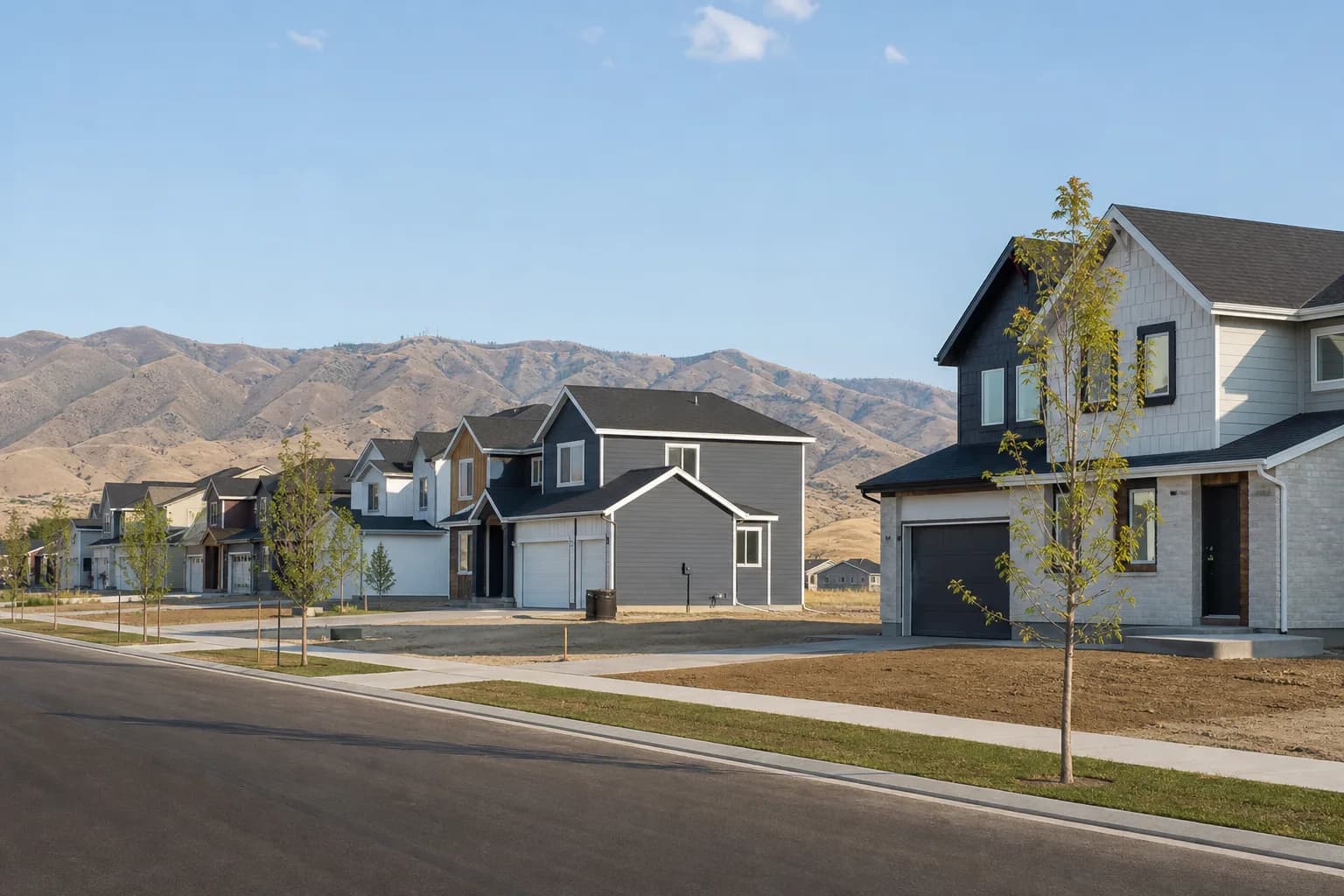
A production builder develops land, builds a limited catalog of plans on it repeatedly, and sells finished or nearly finished houses. The model runs on repetition. The same framing crew builds the same plan for the eleventh time, the trusses are already engineered, the permit set has already been through plan review, and the supplier pricing is locked at volume.
That repetition is not a compromise; it is a genuine advantage. The eleventh version of a house is better built than the first, because everyone involved already knows where the difficult details are. Production builders in Meridian, Nampa and Kuna deliver a lot of well-constructed homes at prices a custom builder cannot match on the same square footage, and pretending otherwise would be dishonest. What you give up is influence. The plan is the plan, the lot is the lot, and your choices come from a menu.
What a custom builder actually is
Expand section
What a custom builder actually is
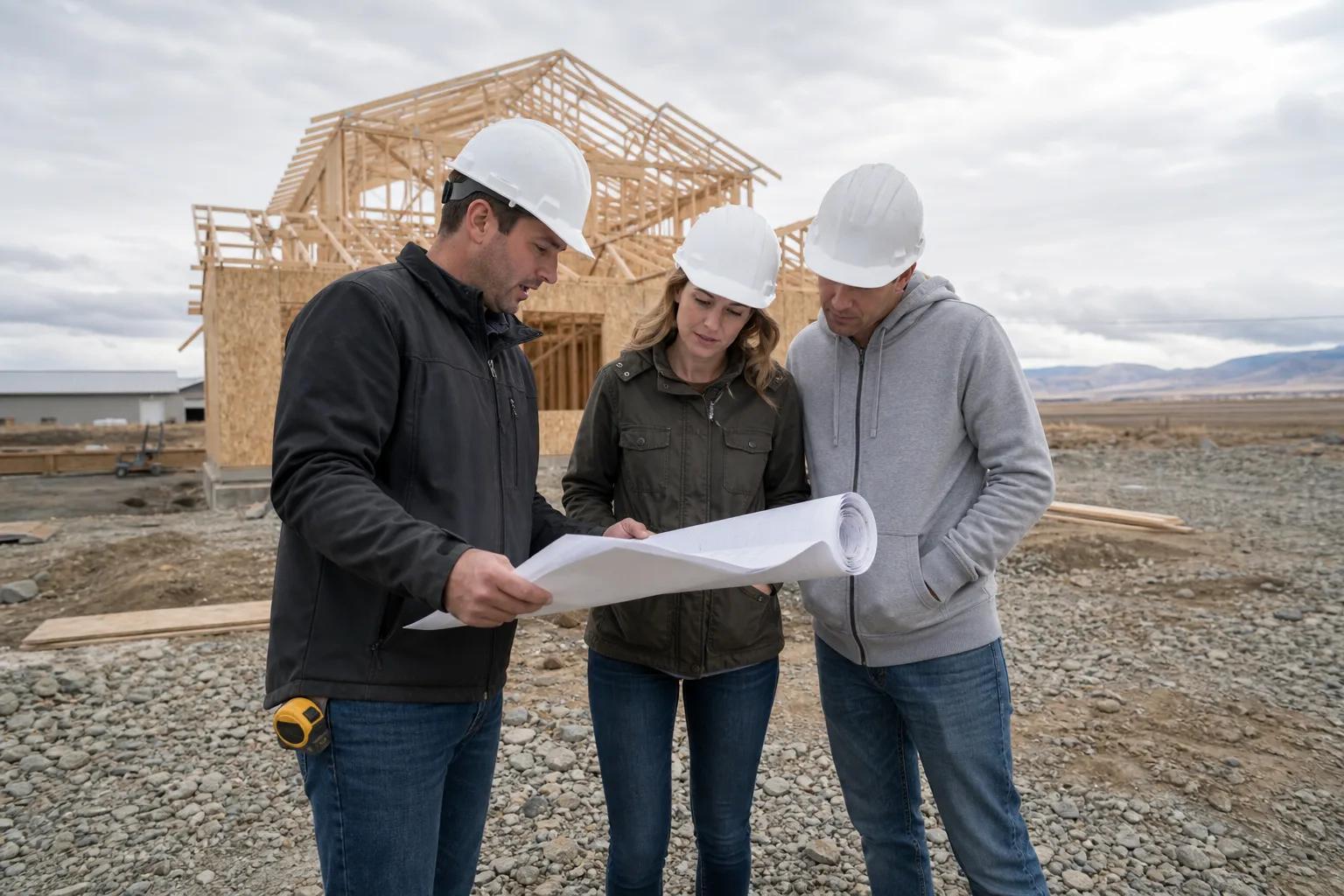
A custom builder starts with your lot and your requirements and produces a house that has never been built before. Every dimension, every structural condition and every specification is decided for your project, which means every one of them has to be decided.
That is the part people underestimate. A custom home involves several hundred decisions across design, engineering and selections, and they arrive over months, often faster than you would like. The reward is a house shaped around how you actually live: the ceiling heights you want, the window wall facing the view you bought the lot for, the shop attached to the house, the single-level plan with no step at the entry because of what you expect the next twenty years to look like. The cost is your time and a wider range of possible outcomes on both price and schedule.
Semi-custom: the middle most people actually want
Expand section
Semi-custom: the middle most people actually want
Semi-custom starts from an existing plan and changes it for your lot and your family, and it is the right answer more often than either extreme. You keep the advantages of a plan that has been drawn, engineered and built before, and you spend your design effort on the handful of things that genuinely matter to you.
The pricing reflects that. Semi-custom homes in the Treasure Valley commonly run $225 to $300 per finished square foot excluding land, or roughly $450,000 to $600,000 for 2,000 square feet, against $250 to $400 per finished square foot for a fully custom home. The saving is mostly design and engineering, not construction, because the house still gets built the same way by the same trades. If your list of changes is five items long rather than fifty, semi-custom will get you there faster and cheaper than starting from a blank page.
Plan flexibility
Expand section
Plan flexibility
Production offers options; custom offers changes. The distinction sounds like semantics and is not.
A production option is a pre-engineered, pre-priced variant: the study becomes a fourth bedroom, the covered patio extends, the garage gains a bay, the great room gains a fireplace. You select from the menu before construction and the price is known. A custom change is anything you want, evaluated for structure, cost and code, then drawn. If you want the ceiling in the main living space at eleven feet, the pantry moved, the laundry connected to the primary closet, and the roof simplified to reduce cost, only one of these models will do that.
The test worth applying is whether you can name three specific things you would change about a production plan you have walked. If you cannot, the flexibility you are paying for in a custom build is flexibility you will not use.
Lot choice
Expand section
Lot choice
With a production builder you choose from their lots; with a custom builder you choose the lot first and the house second. This is often the real decision hiding inside the question.
Production builders control their land because the model depends on it: streets built in sequence, crews moving down the block, utilities and roads installed as one project. That gives you a serviced lot with known site work, commonly $25,000 to $50,000, already reflected in the price. What it does not give you is an acre in the Eagle foothills, a parcel with water rights near Star, or the piece of ground your family already owns.
If the lot matters more to you than the plan does, the decision is already made, because custom building is the only route to a specific piece of ground. It is also the route where site conditions become your problem: a rural parcel needing a well, a septic system through Central District Health, and an access drive runs $80,000 to $150,000 before a foundation is poured. Our guide to buying land to build on in the Treasure Valley covers what to check before you commit.
Selection freedom
Expand section
Selection freedom
Production builders run a design center with curated packages; custom builders send you to suppliers with an allowance. Both approaches have real advantages and the better one depends entirely on you.
A design center is efficient. The options have been chosen to work together, the pricing is fixed, the lead times are known, and you can finish selections in a couple of appointments. The constraint is the catalog, and the upgrade pricing inside a design center is usually where a production builder recovers margin, so the base price and the price you actually pay can differ substantially.
Open selections give you the whole market and the responsibility that comes with it. You can specify the exact tile, the exact plumbing fixtures and the exact window package, and you can also spend four months doing it and land above your allowances. Neither is better in the abstract. Ask yourself honestly whether you enjoy this part.
Predictability of price and schedule
Expand section
Predictability of price and schedule
Production wins on predictability, and it is not close. The plan is drawn, the permit path is known, the lot is developed, and the trades have built the house before. The price you are quoted is usually the price you pay, adjusted for the options you select.
Custom building carries more variance in both directions. The design phase takes time before construction can start, plan review runs on different cadences in Ada and Canyon County, site conditions can surprise you, and selections drift. A custom build commonly runs nine to fourteen months of construction with a design and permitting phase in front of it. Good practice narrows that variance considerably: a line-item budget before ground breaks, allowances set at real local pricing, and a published draw schedule. But it does not eliminate it, and a builder who tells you otherwise is overselling. Our home building cost guide sets out the bands honestly.
Side by side
Expand section
Side by side
| Production | Semi-custom | Custom | |
|---|---|---|---|
| Plan | Fixed catalog | Existing plan, modified | Drawn for you |
| Lot | Builder controlled | Yours or theirs | Yours |
| Selections | Design center menu | Guided, wider | Open |
| Typical cost per finished sq ft | Lowest of the three | $225 to $300 | $250 to $400 |
| Predictability | Highest | High | Depends on the specification |
| Your time commitment | Weeks | Months | Most of a year |
Who a production builder is right for
Expand section
Who a production builder is right for
Buy a production home if the plan works, the location works, and the predictability is worth more to you than the control. That covers a lot of people, including plenty who came to us first.
Specifically: first-time buyers who need a known number and a known date. Families relocating to the valley on a schedule with a house to sell somewhere else. Anyone who walked three model homes and liked one of them without immediately mentally rearranging it. Anyone whose budget is tight enough that a five percent overrun would be a genuine problem, because production pricing is the most reliable protection against that. And anyone who simply does not want to spend a year making decisions about drywall corners and cabinet reveals, which is a completely reasonable preference.
Who a custom builder is right for
Expand section
Who a custom builder is right for
Build custom when the lot, the plan or the way you live cannot be satisfied by an existing house. The clearest cases are the ones where a production plan physically cannot go where you want it.
That includes building on land you already own, a sloped or foothills site that needs a plan designed around the grade, a shop home or barndominium, a multigenerational layout with a genuinely separate suite, a single-level plan built for aging in place, or a performance target above code that changes the wall assembly rather than just the equipment. It also includes the aesthetic case: if you have a clear idea of the house you want and no catalog contains it, no amount of good production building will make you content with the closest match. Before you commit, ask the same questions of every builder and compare the answers, because the custom route depends far more on the specific company than the production route does.
Work out which one you are
Expand section
Work out which one you are
If you are genuinely undecided, the fastest way to find out is to walk two or three production models and write down what you would change. A short list means buy the house. A long list means the plan is the problem, and semi-custom or custom is where you should be looking. When you get to that point, tell us about your lot and your list, or run the numbers first with the build cost calculator. If you are already collecting proposals, how to compare home builder bids is the next thing to read.